.svg)

IT teams today are drowning in tickets, repetitive queries, and manual processes that slow down service delivery. ITSM AI is changing that by bringing automation, prediction, and intelligence into everyday IT support workflows. Among the platforms leading this shift, Jira Service Management (JSM) stands out for how naturally it blends AI into ticketing, request management, and knowledge sharing. This blog explores what ITSM AI really means, why it matters, and how JSM puts these capabilities into practice — from smarter ticket handling to AI-assisted request type setup — so your IT team can move faster with less guesswork.
1 . What Is ITSM AI? Understanding the Basics
ITSM, or IT Service Management, refers to how organizations design, deliver, and support IT services — covering everything from incident resolution to change management. ITSM AI takes this a step further by embedding artificial intelligence directly into these processes, allowing systems to categorize tickets, predict issues, and recommend solutions without constant manual input.
Traditional ITSM tools relied heavily on static workflows and human triage, which worked fine at small scale but broke down as ticket volumes grew. ITSM AI addresses this by learning from historical data and user behavior to make service delivery faster and more consistent.
Jira Service Management is one of the platforms leading this shift, integrating AI capabilities directly into everyday IT workflows rather than treating them as an add-on.
What ITSM AI typically includes:
-
Automated ticket classification and routing
- AI-generated response suggestions
- Predictive alerts for recurring incidents
- Smart search across knowledge bases
- Natural language setup and configuration assistance
2 . Why ITSM AI Matters for Modern IT Teams
Traditional ITSM processes often struggle with slow ticket resolution, inconsistent triage, and knowledge that's scattered across teams. As organizations scale, these inefficiencies compound — agents spend more time sorting tickets than solving them, and end users wait longer for basic requests.
ITSM AI directly addresses these gaps by automating repetitive decisions and surfacing relevant information at the right moment. Instead of an agent manually reading, categorizing, and assigning every ticket, AI can do this instantly based on patterns learned from past data.
|
Traditional ITSM Challenge |
How ITSM AI Helps |
|
Manual ticket categorization |
Auto-classifies and routes tickets instantly |
|
Repetitive L1 queries overload agents |
AI chatbots/virtual agents deflect common requests |
|
Reactive incident response |
Predictive alerts flag issues before escalation |
|
Scattered knowledge across teams |
AI surfaces relevant articles automatically |
|
Slow, manual setup of workflows |
AI recommends structures based on plain-language input |
The business impact is measurable: faster resolution times, reduced operational costs, and a better experience for both IT teams and the employees they support.
3 . Key ITSM AI Features Inside Jira Service Management
ITSM AI isn't a single feature — it's a set of capabilities woven across the entire service management lifecycle, from the moment a ticket is raised to how incidents, changes, and reports are handled afterward. Jira Service Management brings many of these capabilities together natively, rather than requiring separate tools or plugins. Below are the core areas where ITSM AI makes the most noticeable difference for IT teams.
3.1 AI Ticketing & Automated Triage
ITSM AI auto-categorizes incoming tickets based on content, urgency, and historical patterns, removing the need for agents to manually sort every request. JSM combines this with its built-in automation rules, so once a ticket is classified, it can trigger routing, notifications, or escalation without human intervention — cutting down response time significantly.
3.2 AI-Powered Service Desk & Chatbots
Virtual agents now handle a large share of Level 1 (L1) queries, such as password resets or access requests, before they ever reach a human agent. Jira Service Management offers virtual agent capabilities that help deflect repetitive queries, freeing up IT staff to focus on higher-value, complex issues that actually require human judgment.
3.3 Predictive Incident Management
Rather than waiting for systems to fail, ITSM AI analyzes patterns in historical incident data to flag potential outages or performance issues in advance. This shift from reactive to proactive management helps teams address root causes before they impact end users.
3.4 Smart Knowledge Base & Self-Service
ITSM AI can automatically surface the most relevant knowledge base articles based on a user's query, reducing the need for them to raise a ticket at all. JSM's integration with Confluence, paired with AI-suggested articles, means self-service becomes genuinely useful instead of a static, underused feature.
3.5 AI-Assisted Change & Release Management
Change management often involves reviewing risk, checking dependencies, and coordinating approvals — tasks that ITSM AI can help streamline. JSM can use AI to flag high-risk changes based on historical incident correlation, helping teams avoid changes that are statistically more likely to cause disruptions.
3.6 Sentiment & Priority Detection
ITSM AI can analyze the tone and urgency of a ticket's language to help prioritize requests more accurately, rather than relying solely on manually selected priority fields. This helps ensure that a frustrated user reporting a critical issue doesn't get buried behind lower-urgency requests simply because of how the ticket was labeled.
3.7 AI-Generated Reports & Insights
Instead of manually building dashboards, ITSM AI can generate summarized insights on ticket trends, recurring issues, and team performance. JSM's reporting tools, enhanced with AI-driven summarization, make it easier for IT managers to spot patterns without digging through raw data themselves.
4 . ITSM AI vs AIOps: What's the Difference?
These two terms are often used interchangeably, but they serve different purposes. ITSM AI focuses on improving service management — ticketing, requests, incident handling, and user-facing support. AIOps (AI for IT Operations), on the other hand, focuses on the underlying infrastructure — monitoring systems, servers, and networks to detect anomalies at the operational level.
In practice, the two complement each other well. AIOps might detect a server performance anomaly before it causes an outage, while ITSM AI ensures that if an incident is logged, it's triaged, routed, and resolved efficiently. Organizations that combine both get end-to-end intelligence — from infrastructure monitoring all the way through to user-facing ticket resolution.
Quick comparison:
-
ITSM AI → service desk, tickets, requests, knowledge management
- AIOps → infrastructure monitoring, anomaly detection, root cause analysis
- Together → proactive detection + efficient resolution
5 . Why Jira Service Management Stands Out as an ITSM AI Platform
Several platforms — including ServiceNow, Freshservice, and Jira Service Management — have added AI capabilities in recent years, each with its own strengths depending on organizational needs and existing tool ecosystems.
Jira Service Management has emerged as a strong contender in the ITSM AI space, particularly for teams already embedded in the Atlassian ecosystem. With features like Atlassian Intelligence, JSM helps teams summarize tickets, suggest responses, and automate routine workflows — making it a practical entry point for organizations exploring ITSM AI without a complete platform overhaul.
What makes JSM a practical choice:
-
Native integration with Jira, Confluence, and other Atlassian tools
- Atlassian Intelligence for summarization and response suggestions
- Lower learning curve for teams already using Atlassian products
- Scalable from small IT teams to enterprise service desks
This isn't to say JSM is the only option — the right platform depends on your existing stack, budget, and specific workflow needs — but it's a solid, well-supported choice worth evaluating.
6 . How ITSM AI Helps Teams Set Up the Right Request Types (JSM Example)
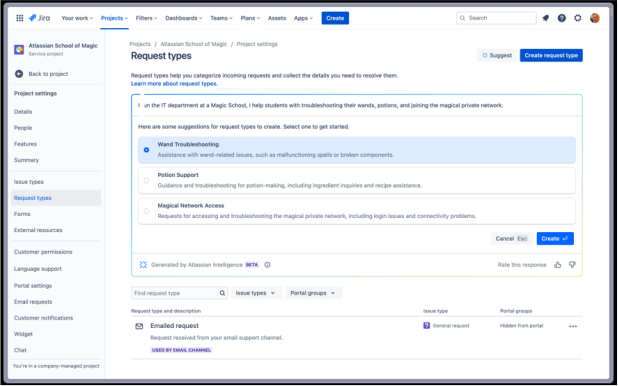
One of the most overlooked parts of ITSM setup is configuring request types — the categories customers use to raise a ticket (e.g., "Reset Password," "Request New Software," "Report an Outage"). New IT teams often don't know what request types they actually need, and established teams tend to keep reusing old templates even when they no longer fit. This is exactly where ITSM AI can remove the guesswork.
Jira Service Management now uses ITSM AI to recommend suitable request types based on a simple description of what your team does — cutting down setup time from hours of guesswork to a few minutes.
Step-by-Step: Setting Up Request Types with AI Assistance
6.1 Go to your service project's configuration area
Open the request type management section within your ITSM platform's project settings.
6.2 Trigger the AI suggestion tool / Atlassian Intelligence
Look for an AI icon or "Suggest" option — most modern ITSM platforms surface this directly on the request type screen.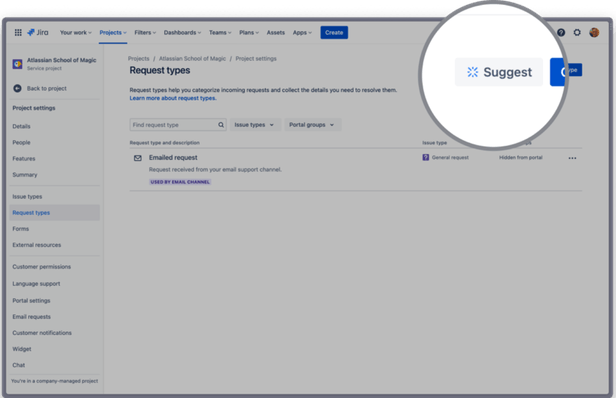
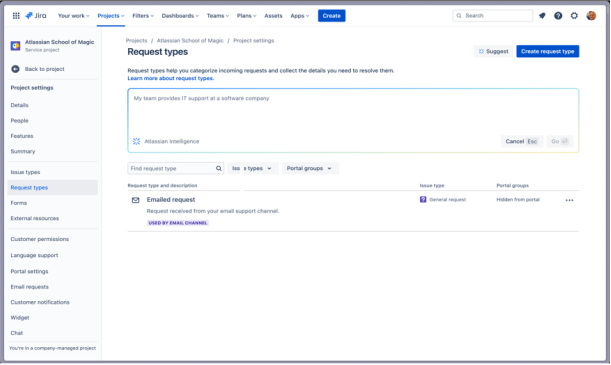
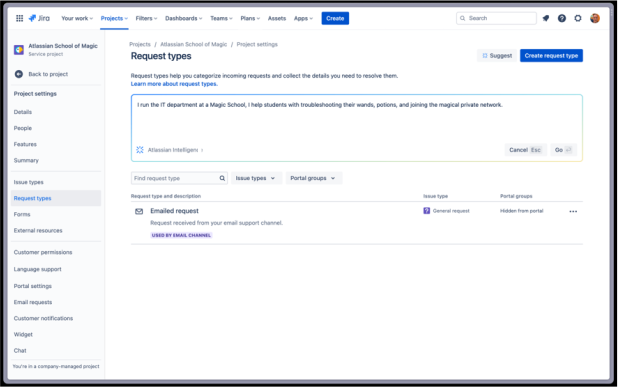
6.3 Describe your team in plain language
Instead of manually building categories from scratch, type a short sentence like "We handle internal IT support for a mid-sized marketing agency."
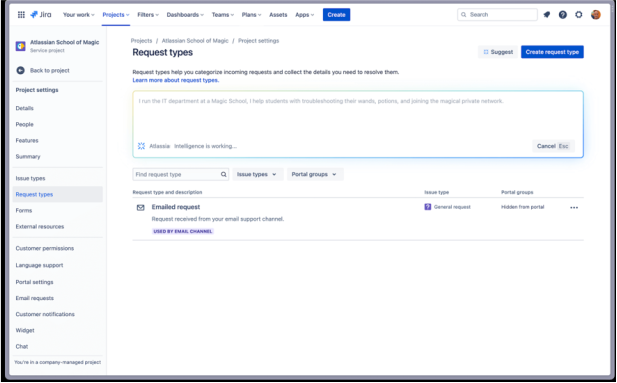
 6.4 Let the AI generate options
The system processes your input and returns a curated list of request types tailored to your description — no templates, no trial and error.
 6.5 Review and select what fits
Pick the request types that align with your team's actual workload, and skip the ones that don't apply.
 6.6 Refine as needed
Most platforms let you tweak field names, forms, or workflows after AI generates the base structure — keeping a human in the loop for final accuracy.
7 . How to Choose the Right ITSM AI Platform for Your Team
Choosing an ITSM AI platform isn't just about picking the tool with the most AI features — it's about finding one that fits your team's workflows, existing tech stack, and growth plans. Below are the key factors worth evaluating, along with what to actually look for or ask when assessing a platform against each one.
Key factors to evaluate:
-
Scalability
Can the platform grow with your team from a handful of agents to an enterprise-wide service desk?
What to look for: Confirm the platform supports tiered licensing and multi-team/multi-project setups, so it doesn't require a full re-implementation as your IT organization grows. - Integrations
Does it connect easily with your existing tools (development, communication, monitoring)?
What to look for: Check for native or marketplace integrations with tools you already use — Slack, monitoring systems, CI/CD pipelines — to avoid building custom connectors from scratch. - Ease of AI adoption
How much setup or training is required to start using AI features effectively?
What to look for: Prioritize platforms where AI features work out-of-the-box with minimal configuration, and confirm vendor-provided onboarding or training resources are available. - Pricing
Are AI features included, or do they require a premium tier?
What to look for: Get clear pricing breakdowns for AI-specific add-ons upfront, so budgeting doesn't get derailed after rollout begins. - Data governance
How does the platform handle AI training data, privacy, and security compliance?
What to look for: Ask for documentation on data residency, retention policies, and compliance certifications (e.g., SOC 2, GDPR) relevant to your industry.
Platforms like JSM are worth evaluating against these criteria alongside competitors, since the "best" platform ultimately depends on your team's specific context rather than a one-size-fits-all answer.
8 . The Future of ITSM AI: What's Next?
ITSM AI is moving quickly from simple automation toward more autonomous, context-aware systems. Agentic AI — where AI doesn't just suggest actions but takes them independently within defined boundaries — is becoming a bigger part of the conversation, alongside generative AI copilots that can draft entire responses or resolution plans.
Deeper integration between ITSM AI and AIOps is also expected, creating a more seamless flow from infrastructure detection to service desk resolution. This is where Jira Service Management is particularly well-positioned. Atlassian has been investing heavily in AI across the platform — through Atlassian Intelligence and Rovo — making JSM one of the more forward-looking ITSM tools rather than one playing catch-up.
Atlassian Intelligence already powers ticket summarization, response drafting, and virtual agent conversations within JSM, and this foundation is expected to expand further into more autonomous, agent-driven workflows. Rovo adds another layer on top of this, bringing enterprise-wide search and AI agents that can pull context from across Jira, Confluence, and connected tools — meaning JSM isn't just adding AI to service management in isolation, but connecting it to the broader flow of work across an organization.
For teams already using or considering JSM, this matters because upgrades to ITSM AI capabilities are likely to roll out as part of the platform's ongoing development, rather than requiring a separate AI tool or a major re-implementation down the line. In other words, teams standardizing on Jira Service Management today are also positioning themselves to benefit from Atlassian's broader AI roadmap tomorrow.
Trends to watch heading into 2026 and beyond:
-
Agentic AI handling end-to-end ticket resolution — an area Atlassian is actively developing within JSM through Rovo agents
- Generative AI copilots drafting full responses, not just suggestions, building on JSM's existing Atlassian Intelligence features
- Tighter ITSM–AIOps integration for proactive service management
- AI-driven governance and compliance tooling, an increasingly important focus area as JSM adoption grows in regulated industries
9 . Why Choose Empyra for Your ITSM AI Journey
Adopting ITSM AI is easier with the right implementation partner behind you — one who understands both the technology and the day-to-day realities of IT service delivery. Empyra is an Atlassian Platinum Solution Partner, backed by 80+ certified Atlassian experts and over 1,000 successful consulting and implementation engagements across industries.
This means Empyra doesn't just set up Jira Service Management — the team helps configure AI-powered workflows, automation, and Atlassian Intelligence features around your specific IT support needs, so you get a setup that actually fits your team instead of a generic template.
What Empyra brings to your ITSM AI rollout:
-
Certified Atlassian expertise for JSM implementation and optimization
- Hands-on configuration of Atlassian Intelligence, Rovo, and AI-driven workflows
- Support across implementation, migration, training, and ongoing management
- Proven experience across finance, healthcare, technology, and government sectors
If you're exploring how ITSM AI and Jira Service Management could fit into your IT operations, it's worth talking to a team that's done this at scale. You can Book a free consultation with Empyra's Atlassian experts to assess where your current setup stands and what an AI-powered ITSM roadmap could look like for your organization.
Conclusion: Is Your IT Team Ready for ITSM AI?
ITSM AI is no longer a futuristic concept—it's actively reshaping how IT teams triage tickets, manage incidents, and support end users. Platforms like Jira Service Management show how AI can be embedded into practical, everyday workflows without overwhelming complexity. If your current ITSM setup still relies heavily on manual processes, now is a good time to evaluate where ITSM AI could remove friction.
Whether you're just starting out or refining an existing setup, exploring AI-ready platforms like JSM is a smart next step for your ITSM AI strategy. Partnering with experts in Jira Service Management implementation consulting can help your organization adopt ITSM AI faster, optimize service delivery, and build a more efficient, future-ready IT support operation.
.png?width=364&height=116&name=sales%20radar%20ai%20logo%202026%20%20(280%20x%2084%20px).png)






.svg)