

Modern businesses require fast, scalable, and intelligent IT Service Management (ITSM) platforms to manage incidents, automate workflows, improve employee support, and streamline IT operations. As organizations move toward cloud-first and Agile environments, the comparison between BMC Remedy and Jira Service Management has become increasingly important.
Both platforms offer enterprise-grade ITSM capabilities, including incident management, change management, service request handling, SLA tracking, and automation. However, Jira Service Management has emerged as a preferred solution for businesses looking for a modern, flexible, and DevOps-friendly ITSM platform with faster implementation and lower operational complexity.
In this blog, we compare BMC Remedy vs Jira Service Management across key features, pricing, integrations, usability, scalability, and business value to help organizations choose the right ITSM solution.
1. Understanding Jira Service Management
Jira Service Management is a modern ITSM platform developed by Atlassian that helps organizations manage IT operations, incidents, service requests, assets, and change processes through a centralized platform. It is built to support Agile, DevOps, and enterprise service management workflows with automation and AI-driven capabilities.
Jira Service Management is widely adopted by IT teams, DevOps teams, HR departments, facilities teams, and customer support organizations because of its flexibility and seamless integration with Atlassian tools like Confluence and Jira Software. The platform supports both cloud and Data Center deployment models.
Key Features of Jira Service Management
-
Incident and Problem Management:-Jira Service Management helps IT teams quickly identify, track, and resolve incidents through automated workflows and intelligent ticket routing.
-
Service Request Management:-The platform allows businesses to manage employee and customer requests through customizable service portals and automated approval workflows.
-
SLA Management and Escalation Workflows:-Jira Service Management enables organizations to define and monitor Service Level Agreements (SLAs) based on response and resolution targets.
-
Asset and Configuration Management:_With built-in asset management capabilities, Jira Service Management helps organizations track hardware, software, infrastructure, and service dependencies in one place.
-
AI-Powered Automation:-Jira Service Management uses AI-powered automation to reduce manual work and improve operational efficiency. Businesses can automate ticket assignments, repetitive tasks, approvals, notifications, and incident responses using no-code automation rules and Atlassian Intelligence.
-
Knowledge Management with Confluence Integration:-The platform integrates seamlessly with Confluence to create a centralized knowledge base for employees and support teams. Organizations can publish help articles, troubleshooting guides, FAQs, and internal documentation to improve self-service and reduce ticket volumes.
-
DevOps and CI/CD Integrations:-Jira Service Management supports DevOps collaboration through integrations with CI/CD tools, monitoring platforms, and deployment pipelines.
-
Self-Service Portals and Virtual Agents:-Jira Service Management provides modern self-service portals that allow users to raise requests, search knowledge articles, and track ticket progress easily.
Why Businesses Prefer Jira Service Management
| Capability | Jira Service Management Advantage |
| User Experience | Modern and intuitive interface |
| Automation | Advanced no-code automation |
| DevOps Support | Native integration with Jira Software and Bitbucket |
| Scalability | Suitable for SMBs and enterprises |
| Collaboration | Strong cross-functional team collaboration |
| Deployment | Faster cloud implementation |
| AI Features | Atlassian Intelligence and virtual agents |
2 . Understanding BMC Remedy
BMC Remedy is a traditional enterprise ITSM platform widely used by large organizations to manage ITIL-based service management processes. BMC Remedy, now commonly known as BMC Helix ITSM, provides incident management, problem management, asset management, and enterprise service operations.
BMC Remedy is commonly used in organizations with highly customized enterprise infrastructure and legacy IT environments. The platform is known for its strong ITIL alignment and enterprise governance capabilities.
Key Features of BMC Remedy
-
Incident and Problem Management:-BMC Remedy helps organizations manage incidents and recurring problems through centralized ticket management workflows. IT teams can prioritize incidents, track issue resolution, and perform root cause analysis to minimize service disruptions and improve operational stability.
-
Change Enablement:-The platform supports structured change management processes that help businesses reduce risks during infrastructure or application changes.
-
CMDB and Asset Management:-BMC Remedy includes Configuration Management Database (CMDB) capabilities that allow organizations to maintain visibility into IT assets, configurations, and service dependencies.
-
Enterprise Workflow Automation:-The platform offers workflow automation features that help automate repetitive IT service management tasks and approval processes.
-
ITIL Process Support:-BMC Remedy is designed around ITIL best practices and supports core ITSM processes such as incident, problem, change, and release management.
-
Reporting and Compliance Management:-The platform provides reporting and analytics capabilities that help organizations monitor service performance, SLA compliance, and operational KPIs.
Challenges Businesses Face with BMC Remedy
-
Complex implementation processes
- Higher infrastructure and maintenance costs
- Longer deployment cycles
- Steeper learning curve for teams
- Increased dependency on administrators and consultant
3 . Key Features Comparison: BMC Remedy vs Jira Service Management
Both BMC Remedy and Jira Service Management provide enterprise-grade ITSM capabilities for managing incidents, service requests, assets, and IT operations. However, the way these platforms deliver automation, collaboration, usability, and scalability differs significantly.
Jira Service Management is designed for modern Agile and DevOps-driven organizations that require faster workflows, automation, cloud scalability, and seamless collaboration. On the other hand, BMC Remedy focuses more on traditional enterprise ITSM processes and highly customized ITIL environments.
| Factor | Jira Service Management | BMC Remedy (Helix) |
|
Change management |
✅ | ✅ |
|
Incident management |
✅ | ✅ |
|
Problem management |
✅ | ✅ |
|
Knowledge management |
✅ | ✅ |
|
Self-service |
✅ | ✅ |
|
Asset management |
✅ | ✅ |
|
SLA management |
✅ | ✅ |
|
Integration |
✅ | ✅ |
|
Reporting & Analytics |
✅ | ✅ |
Incident Management and Problem Management
Incident and problem management help organizations identify, track, prioritize, and resolve IT issues efficiently. Both platforms provide incident tracking, SLA monitoring, escalation workflows, and root cause analysis capabilities. However, Jira Service Management delivers stronger collaboration between IT operations and development teams through native DevOps integrations, helping businesses reduce downtime and improve service delivery speed.
Jira Service Management
-
AI-powered ticket routing:-Automatically assigns incidents to the right teams based on rules, priorities, and historical data to reduce response delays.
-
Real-time incident collaboration:-Enables IT, DevOps, and engineering teams to collaborate directly within incidents for faster issue resolution.
-
Automated escalation workflows:-Escalates unresolved tickets automatically based on SLA conditions and priority levels.
-
Major incident management:-Helps organizations manage critical outages through centralized communication and incident tracking.
-
Integrated DevOps visibility:-Connects incidents with deployments, monitoring tools, and engineering workflows for faster root cause analysis.
-
Custom SLA tracking:-Allows teams to monitor response and resolution times using customizable SLA dashboards.
BMC Remedy
-
ITIL-based incident workflows:-Supports structured ITIL processes for enterprise service operations.
-
Centralized ticket management:-Helps organizations manage incidents through categorized queues and workflows.
-
Root cause analysis support:-Provides tools for identifying recurring operational issues and underlying causes.
-
SLA monitoring:-Tracks incident response and resolution timelines across enterprise support teams.
-
Enterprise escalation management:-Supports multi-level escalation processes for large organizations.
-
Operational reporting:-Generates service desk reports and incident performance insights.
Service Request Management
Service request management enables organizations to handle employee and customer requests through automated workflows and self-service portals. Businesses today require faster request fulfilment processes that improve user experience and reduce manual support workloads.
Jira Service Management offers highly flexible request management capabilities with automation, customizable portals, and omnichannel support for modern service operations.
Jira Service Management
-
Customizable request portals:-Allows businesses to create branded and user-friendly service portals for employees and customers.
-
Automated approval workflows:-Reduces manual intervention by automating approvals based on request types and conditions.
- Smart request forms:-Simplifies request submissions using dynamic forms and guided workflows.
- Workflow automation:-Automates repetitive service desk tasks to improve efficiency and reduce delays.
- Self-service capabilities:-Empowers users to find solutions independently through knowledge articles and automated support.
- Multi-channel support:-Enables request submission through portals, email, Slack, and Microsoft Teams.
BMC Remedy
- Enterprise service catalog
Supports centralized management of IT and business service requests. - Request approval management
Enables multi-level approval workflows for enterprise governance. - Service request tracking
Provides visibility into request progress and fulfillment status. - Self-service portal support
Allows employees to raise and monitor support requests. - Workflow customization
Supports customized request processes for complex enterprise environments. - ITIL service management alignment
Helps organizations maintain standardized IT service delivery processes.
Change Management
Change management helps organizations minimize operational risks during deployments, infrastructure updates, and software releases. Effective change management processes improve system stability and reduce service disruptions.
Jira Service Management modernizes change management with AI-powered automation, CI/CD integrations, and real-time deployment visibility that support Agile and DevOps operations.
Jira Service Management
- AI-driven risk assessment
Automatically evaluates deployment risks using historical data and incident patterns. - Automated approvals
Streamlines change approvals based on predefined rules and conditions. - CI/CD integrations
Connects directly with deployment pipelines to improve release visibility and governance. - Change calendar visibility
Provides centralized visibility into upcoming changes and deployment schedules. - Deployment tracking
Helps teams monitor release progress and identify deployment-related incidents. - DevOps collaboration
Improves coordination between IT operations and engineering teams.
BMC Remedy
- Structured change workflows
Supports enterprise-level change approval and governance processes. - CAB management
Helps organizations manage Change Advisory Board approvals effectively. - Risk assessment tools
Enables organizations to evaluate operational impact before implementing changes. - Compliance tracking
Supports regulatory and audit requirements for enterprise environments. - Change scheduling
Provides visibility into planned infrastructure and service changes. - Enterprise governance controls
Ensures operational consistency across large IT environments.
Asset Management
Asset management is essential for tracking infrastructure, services, hardware, and software dependencies across enterprise environments. Effective asset visibility helps organizations improve operational efficiency and reduce service disruptions.
Jira Service Management includes integrated asset and configuration management capabilities that simplify infrastructure tracking and service dependency mapping.
Jira Service Management
- Centralized asset tracking
Helps organizations monitor hardware, software, and infrastructure assets from a single platform. - CMDB capabilities
Maintains relationships between services, systems, and infrastructure components. - Service dependency mapping
Improves incident resolution through connected asset visibility. - Asset lifecycle management
Tracks assets from procurement to retirement. - Infrastructure visibility
Provides better operational insights into connected environments. - Integrated ITSM workflows
Connects assets directly with incidents, changes, and service requests.
BMC Remedy
- Enterprise CMDB management
Supports large-scale infrastructure relationship mapping. - Configuration tracking
Helps businesses maintain accurate infrastructure records. - Asset governance controls
Supports compliance and enterprise operational management. - Dependency mapping
Identifies relationships between systems and services. - Lifecycle monitoring
Tracks enterprise asset utilization and maintenance. - Operational reporting
Generates reports for infrastructure and asset performance.
Knowledge Management
Knowledge management helps organizations improve self-service experiences by providing centralized documentation and support resources. Effective knowledge sharing also reduces repetitive tickets and improves operational productivity.
Jira Service Management integrates seamlessly with Confluence to provide collaborative and AI-powered knowledge management experiences.
Jira Service Management
-
Confluence integration
Connects knowledge articles directly with service requests and incidents.
- AI-powered suggestions
Recommends relevant articles automatically during ticket creation. - Collaborative documentation
Allows teams to create and manage documentation collaboratively. - Self-help support
Enables users to resolve issues independently through knowledge articles. - Reduced ticket volume
Minimizes repetitive requests through accessible documentation. -
Improved employee experience
Helps employees access support information quickly.
BMC Remedy
- Knowledge article management
Supports centralized support documentation creation. - Self-service access
Enables employees to search for support information. - ITIL knowledge processes
Aligns documentation workflows with ITIL standards. - Content categorization
Organizes articles for easier access and maintenance. - Support efficiency improvements
Helps reduce repetitive service desk requests. - Enterprise content governance
Supports controlled documentation management.
Self-Service
Self-service capabilities help organizations reduce support workloads by enabling employees and customers to resolve issues independently. Modern businesses increasingly rely on intelligent self-service portals and automated support experiences.
Jira Service Management delivers user-friendly self-service experiences powered by AI, automation, and customizable support portals.
Jira Service Management
-
Custom help centers:-Allows businesses to create branded support experiences.
- AI-powered virtual agents:-Automates responses for common requests and support issues.
- Smart request forms:-Simplifies ticket submissions with guided workflows.
- Automated request routing:-Sends tickets automatically to the right support teams.
- Omnichannel support:-Supports requests through email, portals, chat, and collaboration platforms.
-
Knowledge-based assistance:-Suggests relevant support articles during request submission.
BMC Remedy
-
Employee self-service portals:-Allows users to raise and track support requests.
-
Knowledge access support:-Provides access to support documentation and service articles.
-
Request tracking visibility:-Enables users to monitor ticket progress.
- Standardized support workflows:-Supports enterprise service request management processes.
- Enterprise request management:-Helps organizations maintain structured service delivery.
- Service catalog accessibility:-Allows employees to request approved business services.
SLA Management
SLA management helps organizations maintain service quality by tracking response times, resolution targets, and operational performance metrics. Effective SLA monitoring improves customer satisfaction and operational accountability.
Jira Service Management
- Custom SLA policies
Allows businesses to configure SLA targets based on priorities and request types. - Automated escalation rules
Automatically escalates tickets when SLA conditions are breached. - Real-time SLA monitoring
Provides live visibility into service performance metrics. - Visual SLA dashboards
Displays operational insights through customizable dashboards. - Performance tracking
Helps teams identify service bottlenecks and delays. - Compliance visibility
Supports better operational governance and reporting.
BMC Remedy
- SLA compliance monitoring
Tracks enterprise service performance against defined targets. - Escalation management
Supports enterprise escalation workflows and notifications. - Operational reporting
Generates SLA and service desk performance reports. - Service tracking visibility
Helps organizations monitor support efficiency. - Enterprise governance support
Maintains operational compliance and accountability. - ITIL-aligned SLA processes
Supports structured service management operations.
AI Features
AI-powered ITSM capabilities help organizations automate repetitive tasks, improve response times, and enhance employee support experiences. Businesses are increasingly adopting AI-driven service management to improve productivity and operational efficiency.
Jira Service Management
- AI-powered ticket summarization
Automatically summarizes incidents and requests for faster analysis. - Smart recommendations
Suggests actions, articles, and workflows based on historical patterns. - Intelligent automation
Automates repetitive service desk tasks and routing processes. - Virtual service agents
Handles common support requests automatically. - Predictive insights
Helps teams identify operational trends and recurring issues. - Improved response efficiency
Reduces manual effort and accelerates service delivery.
BMC Remedy
- AI-assisted support operations
Helps automate repetitive enterprise service desk activities. - Predictive service management
Uses analytics to identify operational risks and patterns. - Chatbot support
Provides automated employee assistance for common requests. - Operational intelligence
- Supports enterprise monitoring and event analysis.
- Automation workflows
Helps organizations improve operational consistency. - Enterprise analytics support
Provides AI-driven operational reporting capabilities.
Reporting and Analytics
Reporting and analytics help organizations monitor service performance, identify operational bottlenecks, and improve decision-making. Real-time reporting enables IT leaders to optimize service operations and improve overall efficiency.
Jira Service Management
- Real-time dashboards
Provides live operational visibility across incidents, SLAs, and requests. - Custom reporting
Allows teams to create reports tailored to business requirements. - Incident analytics
Tracks recurring issues, resolution trends, and service performance. - Executive visibility
Helps leadership teams monitor operational KPIs and business impact. - Visual reporting tools
Improves data interpretation through customizable charts and dashboards. - SLA reporting
Monitors response and resolution performance effectively.
BMC Remedy
-
Enterprise operational reporting
Generates detailed IT service management reports.
-
Service desk analytics
Tracks incident and request performance metrics.
-
Compliance reporting
Supports audit and regulatory reporting requirements. - Performance monitoring
Helps organizations measure operational efficiency. - Custom analytics configuration
Enables enterprises to configure reporting workflows. - ITIL reporting alignment
Supports structured enterprise service reporting.
4 . BMC Remedy vs Jira: Pricing and Licensing
Pricing is one of the most important factors when selecting an ITSM platform because businesses must evaluate not only licensing costs but also implementation, maintenance, scalability, and long-term operational expenses. Modern organizations prefer flexible and transparent pricing models that can scale with business growth without increasing infrastructure complexity.
BMC Remedy Pricing
BMC Remedy generally follows a custom enterprise pricing model based on deployment type, organizational size, number of users, and required ITSM modules.
- Custom enterprise-based pricing structure
- Higher infrastructure and maintenance costs
- Additional implementation and onboarding expenses
- Separate licensing for advanced capabilities
- Pricing varies based on organizational requirements
Jira Service Management Pricing
Jira Service Management plans you can get include flexible and scalable options designed for startups, growing businesses, and enterprises. The platform offers transparent cloud-based pricing that helps organizations choose the right ITSM capabilities based on operational needs, scalability requirements, and team size.
- Free – Ideal for small teams starting with basic ITSM and service request management workflows
- Standard – Best for growing businesses needing advanced collaboration, reporting, and SLA management
- Premium – Includes advanced automation, asset management, AI-powered capabilities, and incident management features
- Enterprise – Designed for large organizations requiring enterprise-grade scalability, advanced security, and centralized governance controls

5 . Integration and Ecosystem Capabilities
One of the biggest advantages of Jira Service Management is its strong integration ecosystem. Modern ITSM platforms must connect seamlessly with development, communication, monitoring, and automation tools to improve operational efficiency and collaboration across teams.
Popular Jira Service Management Integrations
- Jira Software
Jira Service Management integrates directly with Jira Software to connect IT, development, and operations teams for faster incident resolution, bug tracking, and change management workflows. - Confluence
Integration with Confluence helps teams create centralized knowledge bases, documentation portals, and self-service support articles to improve issue resolution efficiency. - Bitbucket
Bitbucket integration enables DevOps teams to connect service requests with code repositories, pull requests, and deployment pipelines for better development visibility. - Slack
Slack integration allows teams to receive notifications, collaborate on incidents, and manage approvals directly within communication channels for faster response times. - Microsoft Teams
Microsoft Teams integration improves collaboration by enabling teams to manage service requests, alerts, and incident discussions without switching platforms. - CI/CD Tools
Jira Service Management integrates with CI/CD tools to automate deployment tracking, change approvals, and release management processes across development pipelines. - Monitoring Platforms
Integration with monitoring and observability platforms helps businesses detect incidents proactively and automate alert-based ticket creation for faster issue resolution.
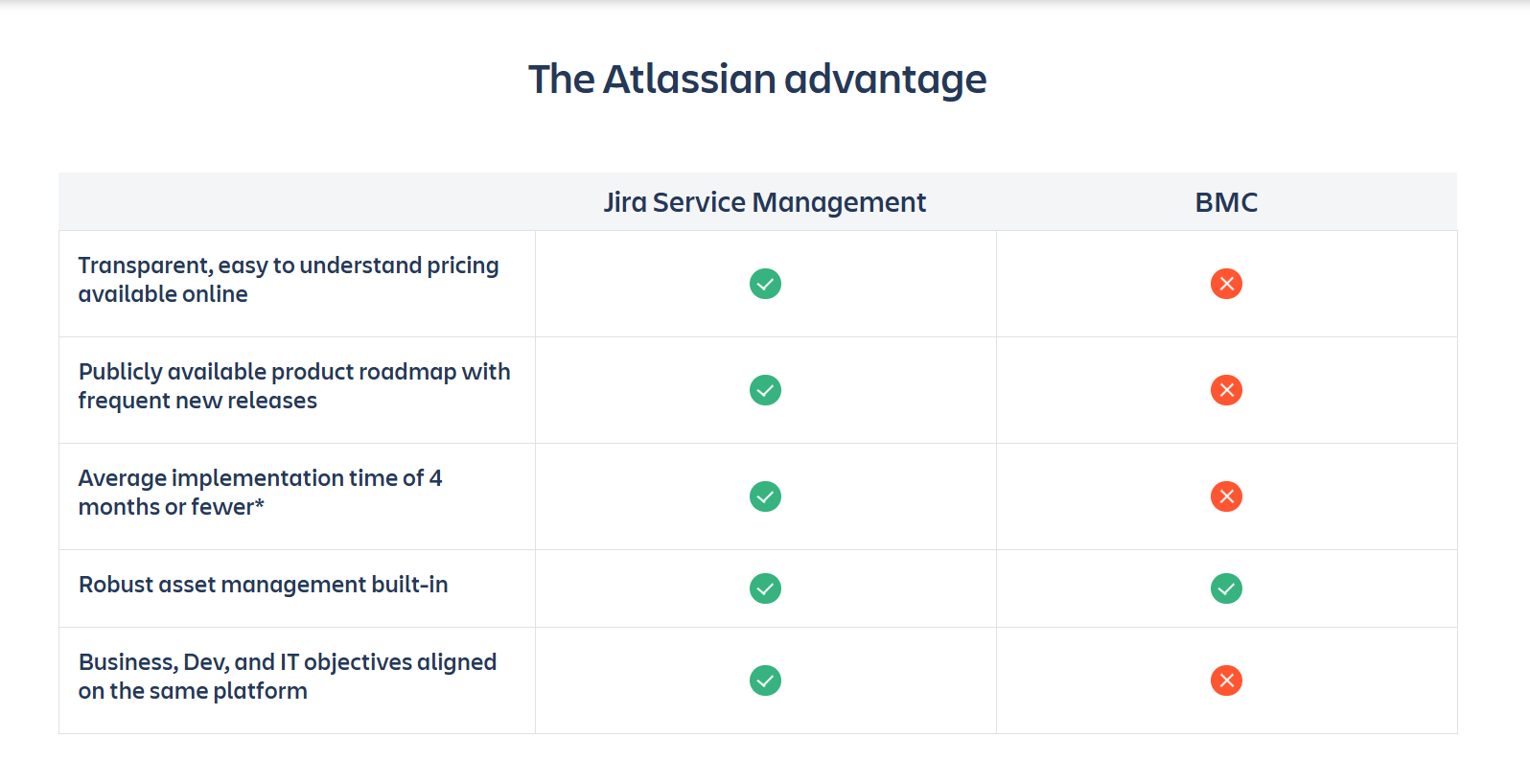
6 . Why Businesses Are Migrating from BMC Remedy to Jira Service Management
Organizations are increasingly migrating from BMC Remedy to Jira Service Management to modernize IT operations and improve service delivery.
Businesses today need cloud-native, automation-driven, and collaborative ITSM platforms that support Agile transformation and DevOps practices.
Common Reasons for Migration
- Lower operational complexity
- Faster implementation
- Better automation capabilities
- Modern user experience
- Reduced maintenance costs
- Stronger collaboration features
- Improved scalability
7 . Which ITSM Platform Should You Choose?
Choosing between BMC Remedy and Jira Service Management depends on your business goals, IT infrastructure, scalability needs, and operational complexity. Both platforms provide ITSM capabilities, but Jira Service Management is better suited for modern businesses looking for flexibility, automation, and faster service delivery.
Choose BMC Remedy If
- Your organization relies heavily on legacy infrastructure
- You need highly customized enterprise IT workflows
- Your IT processes are deeply aligned with traditional ITIL frameworks
- You require complex on-premise service management environments
Choose Jira Service Management If
- You want a modern cloud-based ITSM platform
- Your teams follow Agile and DevOps practices
- You need faster deployment and easier administration
- Your business requires AI-powered automation and scalable workflows
- You want strong integration with Atlassian tools and collaboration platforms
- You are looking for flexible and transparent Jira Service Management pricing
Transform Your ITSM Strategy with Empyra
As an Atlassian Platinum Solution Partner, Empyra helps organizations successfully implement, migrate, optimize, and scale Jira Service Management for modern IT operations.
Whether you are planning to migrate from BMC Remedy, improve service delivery workflows, or modernize your ITSM environment, Empyra’s certified Atlassian experts can help you build a scalable and efficient service management strategy tailored to your business needs.
Conclusion
Both BMC Remedy and Jira Service Management offer strong ITSM capabilities, but modern businesses increasingly prefer Jira Service Management for its cloud-native architecture, automation, DevOps integration, scalability, and user-friendly experience. Compared to traditional ITSM platforms, Jira Service Management delivers faster implementation, lower operational complexity, and better collaboration across IT and business teams. If your organization is planning to modernize service management operations, optimize workflows, or migrate from legacy ITSM systems, Empyra can help. Contact our team today to book a free consultation for Jira Service management Consulting And transform your ITSM Strategy With Certified Atlassian Experts.
.png?width=364&height=116&name=sales%20radar%20ai%20logo%202026%20%20(280%20x%2084%20px).png)



.svg)