Financial Data Company (23)

Beyond Lift and Shift: Rakuten’s Journey Toward an AI-Ready Enterprise Cloud
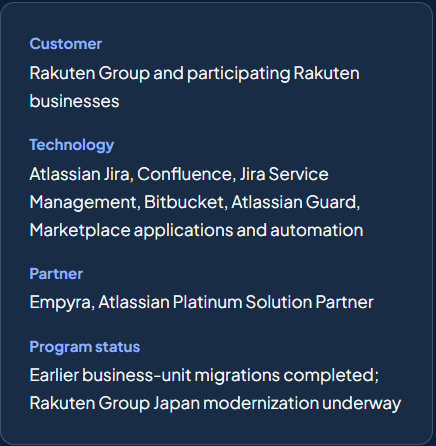
How Empyra’s experience across Rakuten’s international businesses is helping shape the next chapter of enterprise Cloud modernization in Japan
Screenshot 2026-11-02 120219

The challenge: A global enterprise cannot modernize one system at a time

For a global technology company, migration is rarely a matter of moving software from one hosting environment to another. Over time, applications become connected to business processes, identity platforms, internal systems, custom workflows and the knowledge people depend on every day.

Rakuten Group operates more than 70 businesses across a diverse international ecosystem spanning commerce, financial services, digital media and telecommunications. The needs of these businesses are interconnected, but not identical. Its Atlassian environment reflects that complexity.

Different business units have adopted Jira, Confluence and related technologies to support development, collaboration, business operations and service delivery. Across these environments, years of customization, enterprise integrations, Marketplace applications and organizational changes have created dependencies that a simple lift-and-shift migration cannot resolve.

The challenge was bigger than getting data into Atlassian Cloud.

Preserve business continuity

Teams across Rakuten rely on Jira, Confluence and related tools every day for development, collaboration and service delivery. The migration had to protect those workflows, including for the teams already working in Cloud. 

Modernize identity and access management

Identity platforms are tied into the Atlassian environment across business units. The move to Cloud meant replacing legacy identity infrastructure with centralized authentication and stronger security controls that work with Rakuten’s enterprise identity environment.

Decide how to handle legacy customizations

Years of scripts, custom workflows and Marketplace apps may have no exact Cloud equivalent. Each one needed a clear decision on whether to support it in Cloud, redesign it, or treat it as a separate development effort.

Establish a scalable approach

With more than 70 businesses moving at different times, a one-off migration would not be enough. Rakuten needed a repeatable approach that each business unit could follow as it adopts Cloud.

It also needed to make these decisions without disrupting the teams already working in Atlassian Cloud.

The first chapter: Establishing a proven Cloud foundation

Empyra’s engagement with Rakuten extends beyond a single project or geography. Earlier work with Rakuten Rewards, Rakuten Cartera and Rakuten Advertising helped participating businesses advance their Atlassian Cloud adoption.

Rakuten Rewards

For Rakuten Rewards, the transformation involved more than migrating Jira from a self-hosted environment.

The team needed to address enterprise identity requirements across multiple domains, introduce centralized authentication and stronger security controls, assess third-party application compatibility, and reduce the operational burden associated with maintaining self-hosted infrastructure.

Empyra supported a structured migration that included technical assessment, repeated migration testing, application review, production transition, user acceptance testing and enablement.

The work helped Rakuten Rewards adopt Atlassian Cloud with Okta-based single sign-on and two-factor authentication, while supporting continuity of critical business workflows.

An important engineering lesson

The Rakuten Rewards migration also exposed an important engineering lesson: preserving the business function is not always the same as preserving the original technical implementation.

In one documented workflow conversion, legacy Jira fields stored user information as text. To support reliable Cloud-compatible automation, the implementation introduced appropriate user-picker fields, transitioned the existing data and rebuilt the necessary workflow behavior using supported automation capabilities.

What might look like a small configuration change was, in reality, a carefully controlled business-process transformation.

Rakuten Cartera

Similarly, the Rakuten Cartera migration demonstrated the value of sandbox testing, jointly developed cutover planning, transparent issue tracking and dedicated post-go-live support.


These experiences created a practical foundation for addressing more complex enterprise challenges.

The next chapter: Modernizing Rakuten Group’s Japan estate

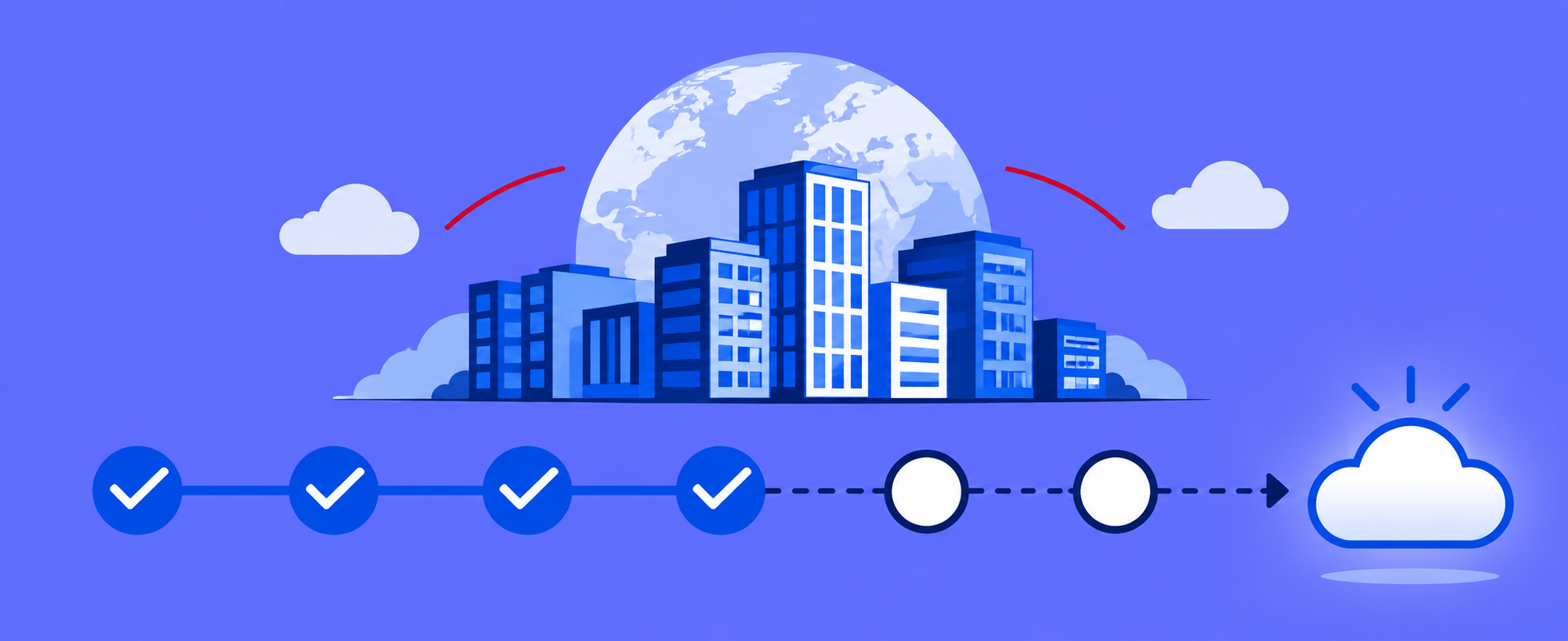
Rakuten Group’s broader Japan Cloud journey was already underway before Empyra’s latest engagement. Rakuten’s internal technology teams and Atlassian had spent significant time assessing the environment, conducting migration rehearsals and moving an initial population of projects to Cloud.

That progress changed the question for the next phase.

Social Media Post-Subhrajit

Empyra’s engagement was structured around that principle. The program brings together remaining Jira and Confluence workloads, Bitbucket migration planning, enterprise identity, application dependencies, custom automation, integration readiness, change management and validation.

The approach is not to migrate every historical configuration unchanged. It is to establish which capabilities the business still needs, select a supported Cloud implementation for each, and produce evidence that the result works.
 

The next chapter Modernizing Rakuten Group’s Japan estate

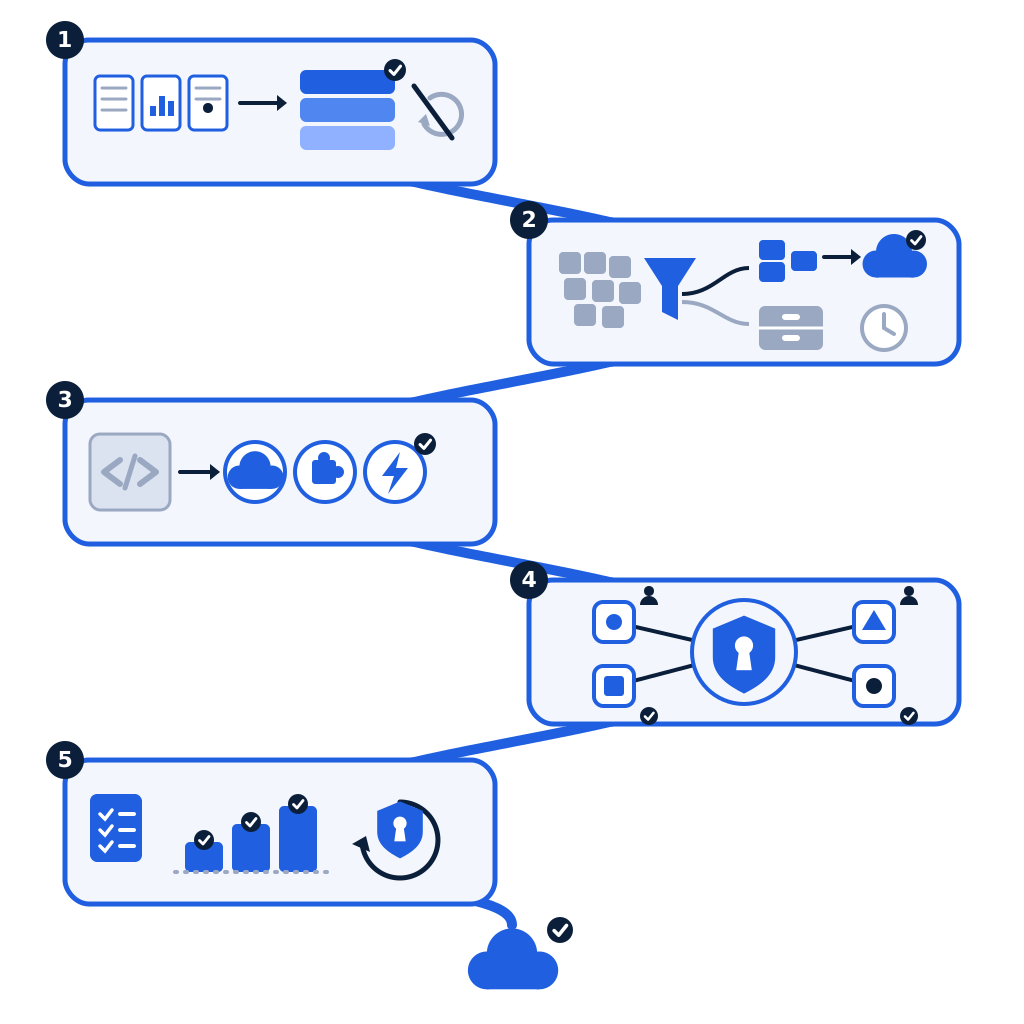
The transformation approach: Five decisions before migration

Preserve what the organization already knows

Prior assessments, migration reports, runbooks and known-issue records are valuable engineering assets.

Empyra’s approach incorporates those existing artifacts into a shared execution baseline. Previously completed work is reviewed for changes and unresolved gaps rather than repeated unnecessarily.

This reduces duplicated effort and allows the team to concentrate on genuine migration blockers.

Decide what deserves to move

Years of projects, spaces, attachments and repositories cannot all be treated with the same priority.

The program distinguishes active business-critical content from historical material, identifies retention requirements and establishes an approved disposition for each category.

Migration waves can then be planned around business dependency, activity and complexity instead of treating the estate as a single undifferentiated workload.

The objective is not merely to move less data. It is to preserve what matters and avoid carrying unnecessary complexity into the future.

Modernize behavior, not just configuration

A Data Center script, HTML macro or Marketplace app may have no exact Cloud equivalent.

That does not automatically mean the associated business process must be abandoned — or that every legacy implementation should be rebuilt as custom software.

The program evaluates native Atlassian Cloud capabilities, supported Marketplace applications, workflow automation and approved process simplification before considering bespoke development.

For complex Confluence content and custom forms, representative proofs of concept help identify which requirements can be supported, which need redesign and which require a separate development decision.

The guiding principle is simple: preserve the business outcome while reducing unnecessary technical debt.

Treat integrations and identity as first-class migration work

Enterprise platforms do not operate in isolation.

Rakuten’s environment depends on business-unit integrations, identity services and multiple application owners.

The modernization strategy includes an integration ownership model, Atlassian Cloud API guidance, dependency tracking, validation responsibilities and coordinated testing.

It also addresses the transition from legacy identity infrastructure toward an Atlassian Guard architecture integrated with Rakuten’s enterprise identity environment.

This creates clearer accountability across the migration.

For every dependency, the team needs to know what changes, who owns the change, how it will be tested and what constitutes acceptance.

Make every migration wave evidence-based

A migration is not complete simply because a tool reports success.

The program defines validation evidence for migrated projects, spaces, configurations and repositories, together with approval checkpoints, exception handling, recovery planning and knowledge transfer.

This is especially important when migrations are performed in waves, different business units move at different times and legacy and cloud environments temporarily coexist.

The goal is to make each wave repeatable, traceable and safe to approve.
five-decisions-graphics-only-no-red

Where AI fits: Readiness before activation

Rakuten has a broader corporate commitment to AI-driven innovation. Its Atlassian modernization presents an opportunity to establish the platform foundations needed for future intelligent teamwork. Those foundations include trusted knowledge, appropriate permissions, clean and well-understood workflows, reliable integrations, and clear ownership of business information.
AI capabilities are only as useful as the information and controls available to them.
 
The current Japan program is therefore best described as building the conditions for future AI-enabled collaboration, not as a completed Rovo deployment or a realized AI productivity transformation.
 
That distinction matters. By addressing fragmented knowledge, unsupported customizations and governance during modernization, enterprises can make future AI adoption a deliberate architectural decision rather than an afterthought.

Results to date and what remains ahead

Empyra’s earlier work across Rakuten businesses demonstrates practical experience in Cloud migration, enterprise identity, workflow conversion, testing and transition support.

For Rakuten Group Japan, the current phase has established an agreed modernization scope and a delivery approach grounded in prior assessment, clear ownership and phased validation.

The remaining production migration and associated business outcomes are still ahead.

Future success will be measured not simply by the volume of data migrated, but by the reliability of business-critical workflows, integrity of information, successful user adoption and the ability to operate and improve the Cloud environment sustainably.

Five lessons for other global enterprises

Start with the work already completed

Start with the work already completed

Existing assessment and migration evidence should accelerate the next phase, not disappear when a new delivery team joins.

Classify before migrating

Classify before migrating

Active, historical, redundant and unsupported assets should not receive the same treatment.

Protect business outcomes, not legacy code

Protect business outcomes, not legacy code

Cloud modernization is an opportunity to simplify technical implementations without losing essential capabilities.

Make ownership explicit

Make ownership explicit

Integration, identity and application dependencies need accountable owners and testable acceptance criteria.

Social Media Post-Subhrajit (6)

Build toward AI deliberately

Trusted data, consistent permissions and maintainable workflows are prerequisites for responsible AI adoption.

A transformation measured in decisions, not just data

For Rakuten, the journey from self-hosted systems to Atlassian Cloud has unfolded across multiple businesses and stages.

The earlier transitions showed what structured migration and enterprise Cloud adoption could deliver. The Japan modernization program builds on those experiences at a larger level of organizational and technical complexity.

The central lesson is that enterprise Cloud transformation begins well before the final cutover.

It begins when organizations make deliberate, evidence-based decisions about how people, processes, information and technology should work together.

Let’s talk about your challenges and how we can solve them—start your Atlassian journey with confidence.

Articles

Our Latest Blogs

October 28, 2026
Atlassian AI costs are measured in Rovo credits. Every paid Jira, Confluence and collection plan includes a mo
October 23, 2026
Atlassian AI agents are becoming visible, accountable teammates, and AMP (Agentic Multiplayer Protocol) is the
October 14, 2026
Jira automation pricing no longer counts flow runs. It counts steps: every trigger, condition, action, branch

Customer Success Stories for Atlassian

See What our customers have to say

Tufts-University_case_study
Tufts University
rakuten-min
Rakuten
victoria-secret-min
Victoria’s Secret
jira-work_converted
Jira Work Management Implementation
OTC_case_study
OTC
Financial-Data-Company-Cloud-Adoption-Success-Story_converted
Financial Data Company Cloud Adoption Success Story

What Our Customers Have to Say

"Empyra has been extremely helpful in getting Cohen & Company’s Atlassian environments up and running. They have been able to provide great guidance in the options available and also have been able to execute on implementation of those options in a timely and effective manner. They have helped us bring in other departments outside of IT to utilize the service desk options to manage requests and workflows with great reviews from those teams."

Chief Technology Officer

Cohen and Company

"The Empyra consultant has allowed us to take the use of Atlassian's Jira product to new levels across the organization, providing significant improvements in workflows in IT as well as many Finance and Operations teams. There have been some complex requests that Empyra have dealt with, and all have been completed professionally, collaboratively, and efficiently. Empyra have always been super responsive, and are keen to work with the various OTC teams to solve their individual business needs."

Roger Abrahams, Senior Vice President - IT

OTC Industrial Technologies

"As our exclusive Atlassian partner, we brought Empyra in to plan, execute and manage our Atlassian migration to the cloud. From pre to post migration activities and support, Empyra was there to support our project team every step of the way. The migration went as smoothly as possible, and there was no major impact to our business operations."

Sr. Manager, Portfolio Management

"I was very pleased with the consistent can-do attitude the Empyra team brought to each meeting, they quickly came up with solutions, suggestions, recommendations on our various challenges and pitfalls during the migration. My team and I really appreciated that the Empyra team made themselves available 24/7 to troubleshoot with us or answered any questions raised in a timely manner."

Sr. Manager, Portfolio Management

"I'd like to extend a heartfelt thank you to the Empyra team for their exceptional support during our migration of Confluence and Jira from server to Cloud including 14 managed apps. Their expertise and dedication were instrumental in navigating this complex transition smoothly. We truly couldn't have achieved this milestone without their guidance and hard work. Their efforts were a crucial factor in the success of our migration project, and we are deeply appreciative of their partnership. Thank you, Empyra, for being such a reliable and effective ally in our journey to the Cloud!"

Gavi Ornelas-Morales, Tools Support, Supervisor

University of California Office of the President

"monday.com and Empyra provided us with a scalable solution that allows my team to respond quickly to client requests. Additionally, the user-friendly UI with improved workflows helped our underwriting team manage the business in one platform alongside business development. Empyra has done a wonderful job and I envision a long-term relationship on a go-forward basis."

Untitled design (14)-Aug-01-2024-09-50-04-7382-AM

Daniel Cottrel

Managing Partner, VasarcaRx

Let’s talk about your challenges and how we can solve them—fill out the form and start your Atlassian journey with confidence.
Let’s talk about your challenges and how we can solve them—fill out the form and start your Atlassian journey with confidence.
Untitled design (21)-1